
Visit to two spectacular wildflower sites in the foothills of the Carolinas — 2021-04-11
Hey Folks, this initial message went out to all of my subscribers a few days ago. I realize now that some of you did not get this message. I have been working with the design team at my hosting site, HostPapa.com, for the past month to revamp the functionality of my blog, and there have been a few hiccups. The new blog design pretty much looks the same, but should run faster and be more efficient. You will probably notice a few minor/subtle changes, but for the most part, it will be the same blog format that I had before.
Toward the bottom of each post and before the comments section, you will find a yellow DONATE button. Please do not be put off by this or feel, in any way, that you should use it. This was placed by the design staff after hearing that I do not receive any funding for the blog through outside sources. I write the blog because I’m passionate about nature photography and about getting out into the wild to share with you my experiences in nature. Clicking on the button will take you to PayPal, where a donation may be made. That’s all it is.
************** Regularly scheduled blog post follows: ***********************
Recently, Walter Ezell and I visited two special wildflower sites in the foothills of the Carolinas. They could be considered to be in the “mountains”, but technically they are at the base of the Blue Ridge Escarpment. The first of these sites is in the uppermost portion of Greenville County, South Carolina — spitting distance from the state border with North Carolina. It is a small site which has recently been added to Jones Gap State Park. This site is one of two or three locations for an odd Trillium species. It has been known about for a number of years, but only recently has work been done to nail down its true identity. Locally, it is known as the “Jones Gap Trillium”, but basically it looks like Trillium catesbaei or Catesby’s Trillium except that its flower is erect to mostly erect above the leaves/bracts rather than hanging below the leaves/bracts as does the typical Catesby’s Trillium.
My neck of the woods, the extreme northwestern portion of South Carolina (called “the Upstate”), is right in the middle of one of the richest Trillium regions of North America. I hesitate to enumerate the Trillium species in our region, but it is in the several dozens. And, as botanical progress moves onward, “new” species and forms are being identified.
This Upstate site is also home to a large population of Aplectrum hyemale or Puttyroot orchid aka Adam-and-Eve orchid. About a year ago, I posted a blog detailing the orchid plants from this site, HERE. Since they aren’t in flower until mid-May, all that was present on this visit is the large, single leaf, which generally withers before bloom time. There were also several other typical Spring ephemerals in flower at the time of our visit. But again, the target species was the Jones Gap Trillium.

Jones Gap Trillium
Tiny white Trillium in the eastern Piedmont of North Carolina — 2021-04-03
A few years ago, my good friend, Kelvin Taylor (aka “KT”) posted some excellent images of Trillium pusillum or Carolina Least Trillium which he had been studying at a preserve called Turkey Creek Preserve near the small town of Middlesex, Nash County, North Carolina. This is not a Trillium species that I see with any frequency at all. In fact, it had been many years since I had been fortunate enough to photograph it, or ones like it. We also found a number of Neottia bifolia or Southern Twayblade orchids. This orchid has been renamed from Listera australis a bit ago as all of the plants in the genus, Listera had been moved to Neottia for reasons known only to the taxonomists… In a minute, I’ll attempt to explain the problems associated with naming the Trillium species we saw, but for now, here are examples of the two target species:

Carolina Least Trillium

Southern Twayblade orchid
More from last weekend in Pickens County, SC — 2021-03-19
This past weekend, several of us made separate field trips to Peach Orchard Branch, Nine Times Preserve, and Laurel Fork Heritage Preserve, all in Pickens County, South Carolina. The Spring ephemeral wildflowers were in perfect bloom. I have managed to visit these sites every Spring for several years, and I am never disappointed in what is displayed before me.
Several of my photography friends have said that this is an early Spring, and a few have said it is a late Spring, but what I found this year is that everything is blooming pretty much right on schedule. I chose to visit Peach Orchard Branch, because it is one of the few sites for Pachysandra procumbens or Allegheny Spurge in South Carolina. We visited Nine Times Preserve (owned and managed by The Nature Conservancy) to see the beautifully colored Hepatica acutiloba or Sharp-lobed Hepatica, as well as Sanguinaria canadensis or Blood Root, and the ever-present Erythronium umbilicatum or Dimpled Trout Lily. That bad boy seems to continue to produce flowers for a couple of weeks. I was even invited to join a few friends on a long hike to Laurel Fork Heritage Preserve near Lake Jocassee to look for Shortia galacifolia or Oconee Bells.

Allegheny Spurge

Sharp-lobed Hepatica

Oconee Bells
The search for a new plant variety discovered in upstate South Carolina — 2021-03-12
This is just a reminder that the website is being worked on to improve its functionality and durability. During this time, you may experience weird stuff such as duplicate posts, certain parts not working properly (Comments section, for instance), and other oddities. I really appreciate your patience with all of this. Frankly, it’s one of the busiest times of the year for me, and I hate not having everything working 100% correctly…
Now, back to our previously scheduled programming…
This past week, I (and a few other interested parties) made two trips up the mountain at The Nature Conservancy’s Nine Time Preserve in Pickens County, South Carolina. It was a very strenuous hike for me, but it was worth it being able to photograph a new-to-science variety of a plant species which is found farther north in the higher reaches of the Southern Appalachian Mountains. So far, this new plant species variety is endemic to this single mountain. This plant variety has been known about for around a decade or so, but it was only recently described by the authors: Laary Cushman, Vincent P. Richards, and Patrick D. McMillan — all of nearby Clemson University. The species variety was named after Dr. Harry E. Shealy, Jr., Distinguished Professor Emeritus at the University of South Carolina in Aiken.
Here are a couple of images of the plant in flower:
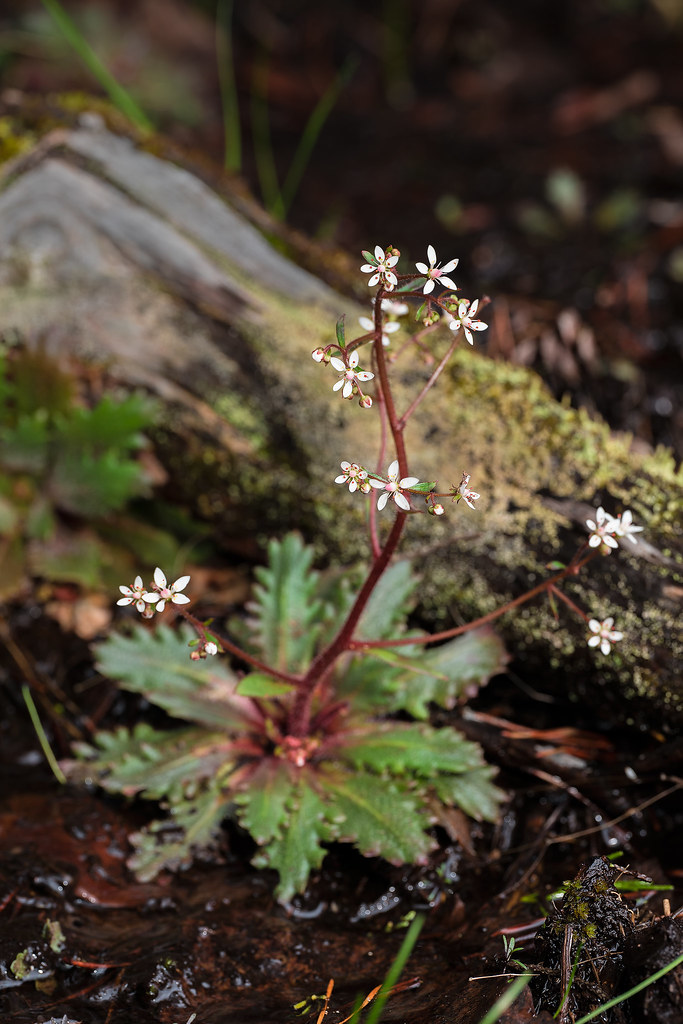
Shealy’s Saxifrage
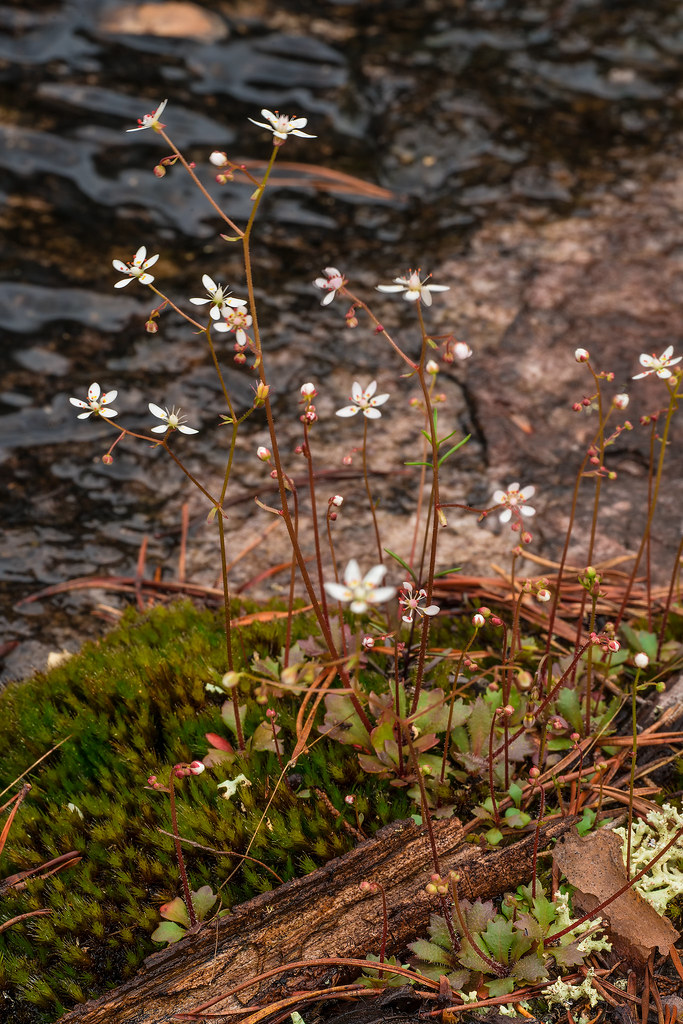
Shealy’s Saxifrage
Nine Times Preserve gets a start on Spring — 2021-03-09
A bit of housekeeping before we get started: Recently, I have been trying to keep this blog up-to-date and to keep all of the parts and pieces working, but recently I have had several issues that are just beyond my ability to cope with. One of them is the Comments section down at the bottom of each blog post. Currently, it no longer works. Additionally, the coding that sends out notifications of new blog posts sent multiple notifications to many of you on the most recent posting — not good, and I apologize for the inconvenience. There are other issues, as well, so I have hired on a website team that is part of my blog hosting company to take over the website upkeep responsibilities. They are in the process of cleaning up the coding and updating all of the parts to make sure it runs smoothly and efficiently. We will see how this works out. It may take a month or so to complete the process; we are not sure at this point what is the entire scope of the project. For now, please bear with me until the work is done.
Now, back to our previously scheduled programming…
The images which are the subject of this post will probably look familiar to you, especially if you perused the most recent blog post — the first post of 2021. Currently, there is not much in bloom in the upstate of South Carolina except Erythronium umbilcatum or Dimpled Trout Lily, although much will come into bloom in the next few weeks. Walter Ezell and I decided to make a trip to our most prolific site for these tiny yellow beauties to catch them at their peak and to look for signs of other wildflowers poking out of the ground. The place I’m referring to is Nine Times preserve, a TNC (The Nature Conservancy) site encompassing more than 500 acres (226 hectares). According to the official website:
“The towns of the native Cherokee people along the Big Eastatoee River were connected by a trail that ran through this area. Travelers between these towns, from early settlers up through the mid-twentieth century, had to cross a two-mile-long tributary of the Little Eastatoee River nine different times in order to stay on the path. This tributary now is known as Nine Times Creek. It parallels the northern border of this 560-acre nature preserve. Nine Times Preserve lies at the intersection of South Carolina’s Southern Blue Ridge Mountains and its piedmont region, where mountainous terrain begins to slope into gentler hills. Black bear, peregrine falcons and freshwater trout are just a few of the species you may find on this incredibly biologically significant property. More than 134 species of native wildflowers bloom in Nine Times Preserve. The preserve encompasses five mountains and seven distinct forest types.”
In order that the subject will not be too boring, I have attempted to make these Dimpled Trout Lily images a bit more “artistic” rather than just documentary. I’m not sure I achieved this goal, but I’m pleased with the results. Here is what we saw on this trip to Nine Times:
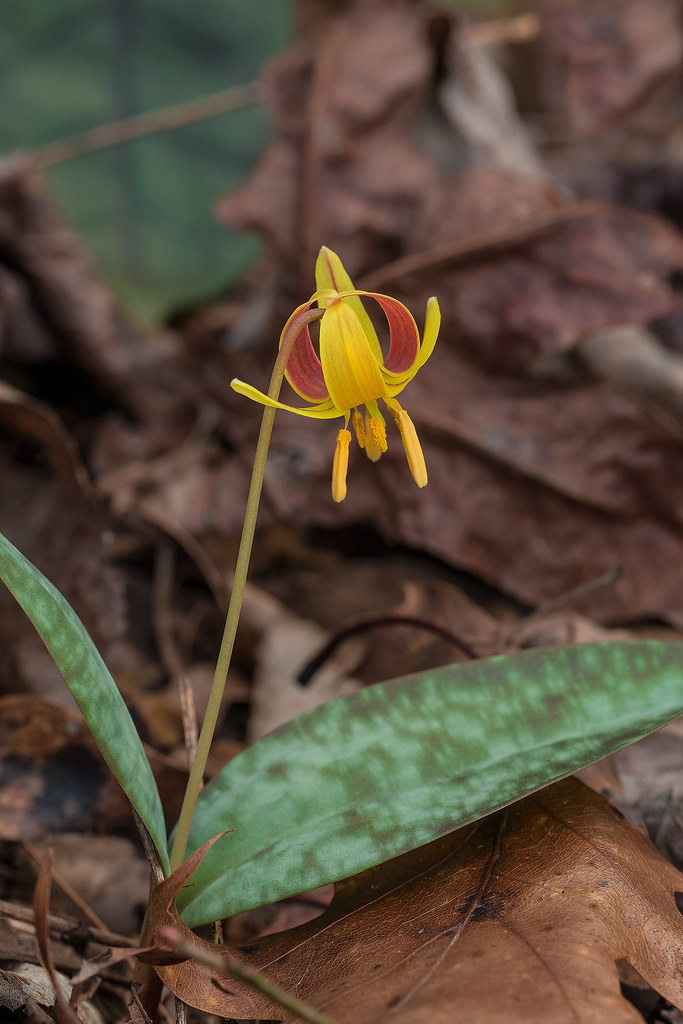
Dimpled Trout Lily